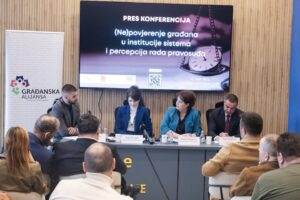
The conference was organized as part of the Human Rights Day programme by Civic Alliance, the Institution of the Protector of Human Rights and Freedoms of Montenegro, and the Council of Europe Programme Office in Podgorica.
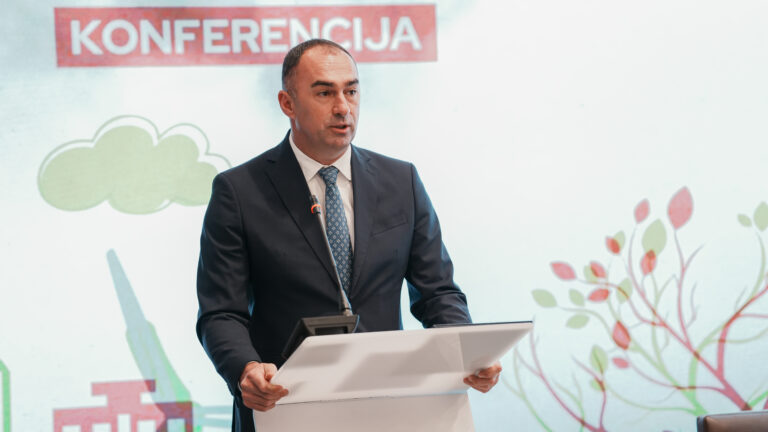
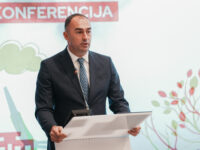
The event was opened by the President of Montenegro, Jakov Milatović, followed by introductory remarks from Fatmir Gjeka, Minister of Human and Minority Rights; Siniša Bjeković, Protector of Human Rights and Freedoms of Montenegro; Lejla Dervišagić, Head of the Council of Europe Programme Office in Podgorica; and Ivan Radulović, Human Rights and Justice Programme Coordinator at Civic Alliance.
The President of Montenegro emphasized the need for an honest reassessment of whether the rule of law truly represents the foundation of society or remains partly trapped within the judiciary’s drawers. He stressed that the rule of law must not be a theoretical concept, but a daily practice that guarantees equality before the law, judicial independence, and decisions that are transparent, timely, and free from undue influence.

He warned that the consequences of a dysfunctional system are most severely felt by citizens – those awaiting judicial protection, victims of violence, workers whose rights are violated, and members of minority communities who feel they are treated unequally before the law. He underlined that the absence of an effective rule of law leads to a loss of trust in institutions and contributes to the emigration of young people who see no prospects in such an environment.
Minister Fatmir Gjeka stated that human rights must be consistently protected and that any institutional failure undermines both the rule of law and public trust. He highlighted that equal application of the law and an independent judiciary are the foundations of a just society, especially in times of serious global human rights violations.

He added that Montenegro can progress only through tangible results in combating corruption, protecting women, and effectively prosecuting hate crimes. “We will continue to open the drawers and build a transparent and accountable system,” Gjeka stated, emphasizing that the rule of law must be the cornerstone of society.
Siniša Bjeković recalled that Human Rights Day symbolizes decades of efforts to develop systems for the protection of rights, noting that while human rights remain unquestionable in principle, they are often inconsistently applied in practice. He stressed the inseparable link between the rule of law and human rights, emphasizing that one cannot exist without the other, and that attempts to separate them are illusory both in theory and in practice.

Speaking about European integration, Bjeković noted that the most important battles for Montenegro’s progress are fought within institutions – particularly judicial ones – which must demonstrate readiness to assume full responsibility and fully implement international standards. He emphasized that society as a whole must work toward unified human rights standards and ensure that judicial “drawers” are closed in a timely and effective manner, as the public rightfully expects results and the judiciary is a key actor in ensuring real protection of rights.
Lejla Dervišagić highlighted that the Council of Europe is built on the principles of peace, justice, and human rights, and that the European Convention remains a “living instrument” of protection even after 75 years, despite contemporary challenges such as hate speech, disinformation, and attacks on media freedom.

She noted that the New Democratic Pact for Europe represents a response to these challenges, aimed at strengthening trust in democratic processes and institutions. As she emphasized, the Council of Europe remains Europe’s moral and legal compass and a reminder that without human rights there can be neither stability nor democratic progress.
Ivan Radulović pointed out that, despite certain progress in aligning with European standards, Montenegro still faces serious challenges in the practical implementation of the rule of law. He stressed that lengthy court proceedings, limited enforcement of regulations, and uneven protection of vulnerable groups remain key obstacles undermining public trust in institutions.

He emphasized that independent courts, a professionally strengthened prosecution service, and institutions free from undue influence are prerequisites for the effective protection of human rights, as without an efficient judiciary, European standards remain only on paper.
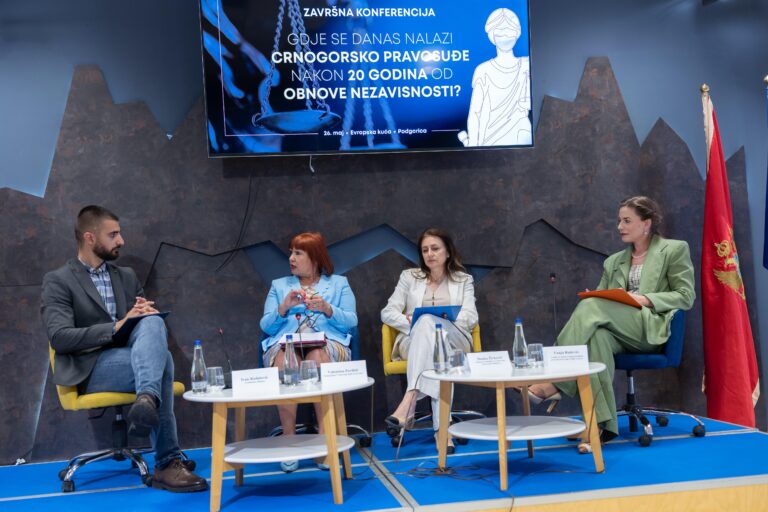
Panelists at the conference included Momo Koprivica, Deputy Prime Minister for Political System, Judiciary and Anti-Corruption; Tatjana Ljujić, Judge of the Supreme Court of Montenegro; and Armin Selmanović, State Prosecutor at the Supreme State Prosecutor’s Office.
Momo Koprivica stated that working conditions in the judiciary should certainly be improved, “but that this cannot serve as an excuse for the lack of results.” He recalled that a new location for the Palace of Justice has been defined and that, regarding the relocation of the Special State Prosecutor’s Office (SDT) to the former Government building, “they had been at a standstill.” “The previous government did adopt a decision, but nothing happened for a year and a half. We completed the tender for adaptation, prepared extensive planning and tender documentation, and the building has been granted protected status,” he said, adding that an appeal by one bidder had been rejected and that works are set to begin in the coming days, with a 60-day deadline, expecting the relocation to take place in February.
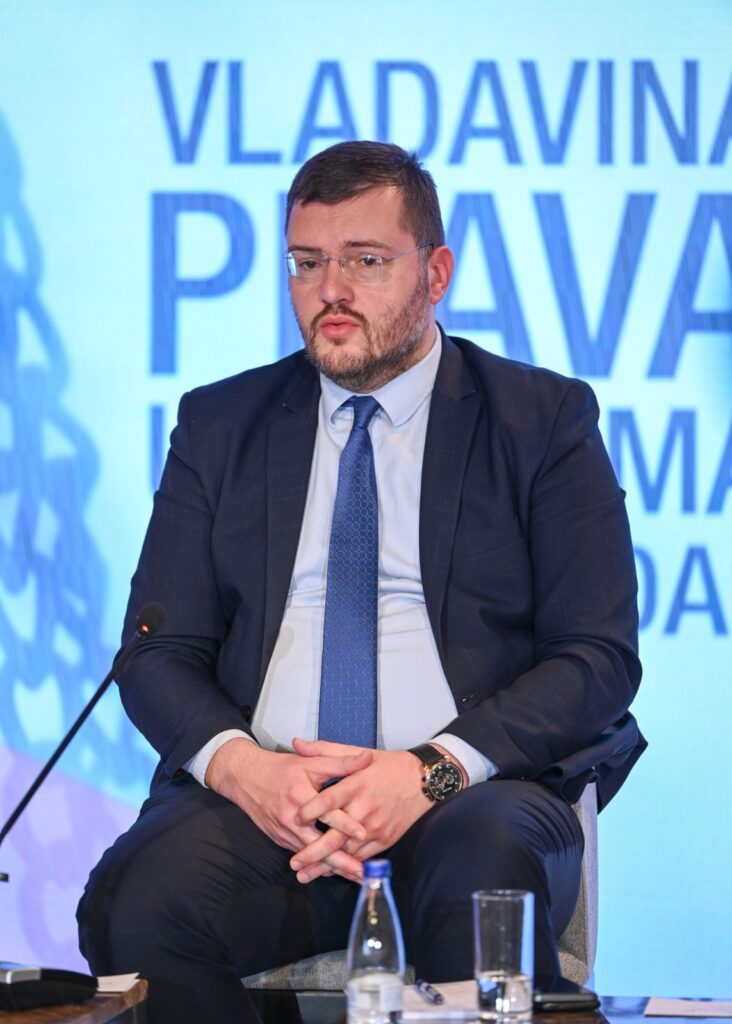
Commenting on the appointment process for the Constitutional Court, Koprivica stated that, although there has been no institutional blockade, the process must remain a priority. He emphasized the need for greater responsibility and dialogue prior to voting, warning that negotiations conducted between voting rounds send the wrong message and create perceptions of political bargaining.
He added that the public has the right to criticism, noting that outcomes are often interpreted negatively regardless of the result. Vetting, he stressed, must be a priority involving all stakeholders, with final decisions to be made by independent bodies rather than politicians. As a key argument for vetting, he cited data showing that in 2024 the Supreme State Prosecutor’s Office submitted 19 requests for the protection of legality, of which the Supreme Court accepted 16.
Tatjana Ljujić highlighted the lack of personnel, infrastructure, and material resources, noting that judges nonetheless make significant efforts to resolve cases, often working overtime. She added that the work of judges is further complicated by a “collective stigma,” where public distrust, driven by individual cases, is generalized to the entire judiciary.
She stressed that responsibility should be individualized and not generalized, stating that overcoming such stigma is necessary for the judiciary to reach its full capacity. She also noted that criminal proceedings are currently being conducted against 11 former and current judges and prosecutors in Montenegro on suspicion of various criminal offences.

Ljujić emphasized that courts are overwhelmed with cases but that efforts are underway to develop professional guidelines for sentencing in cases of serious and organized crime, which should strengthen judicial integrity and contribute to lawful, fair, and timely decisions.
Armin Selmanović stated that criticism is an integral part of democratic processes and that the prosecution views it as an opportunity for improvement. He noted that parliamentary debates on the prosecution’s work have focused less on results, but stressed that political perceptions will not override professional standards and lawful decision-making.

He added that the prosecution has achieved visible progress and implemented significant reforms, emphasizing that there are no cases “in drawers.” “Cases in progress are, as required, stored in files, binders, or packages due to their volume, while the speed of decision-making depends on the complexity of cases such as organized crime, war crimes, and high-level corruption,” he explained.
He also pointed out that the institution has undergone a large number of retirements, resulting in the replacement of nearly half of its prosecutors and a noticeable rejuvenation of staff, concluding that prosecutors “are not afraid of potential vetting.”